AI & Computational Science
AI-drivendrug discovery
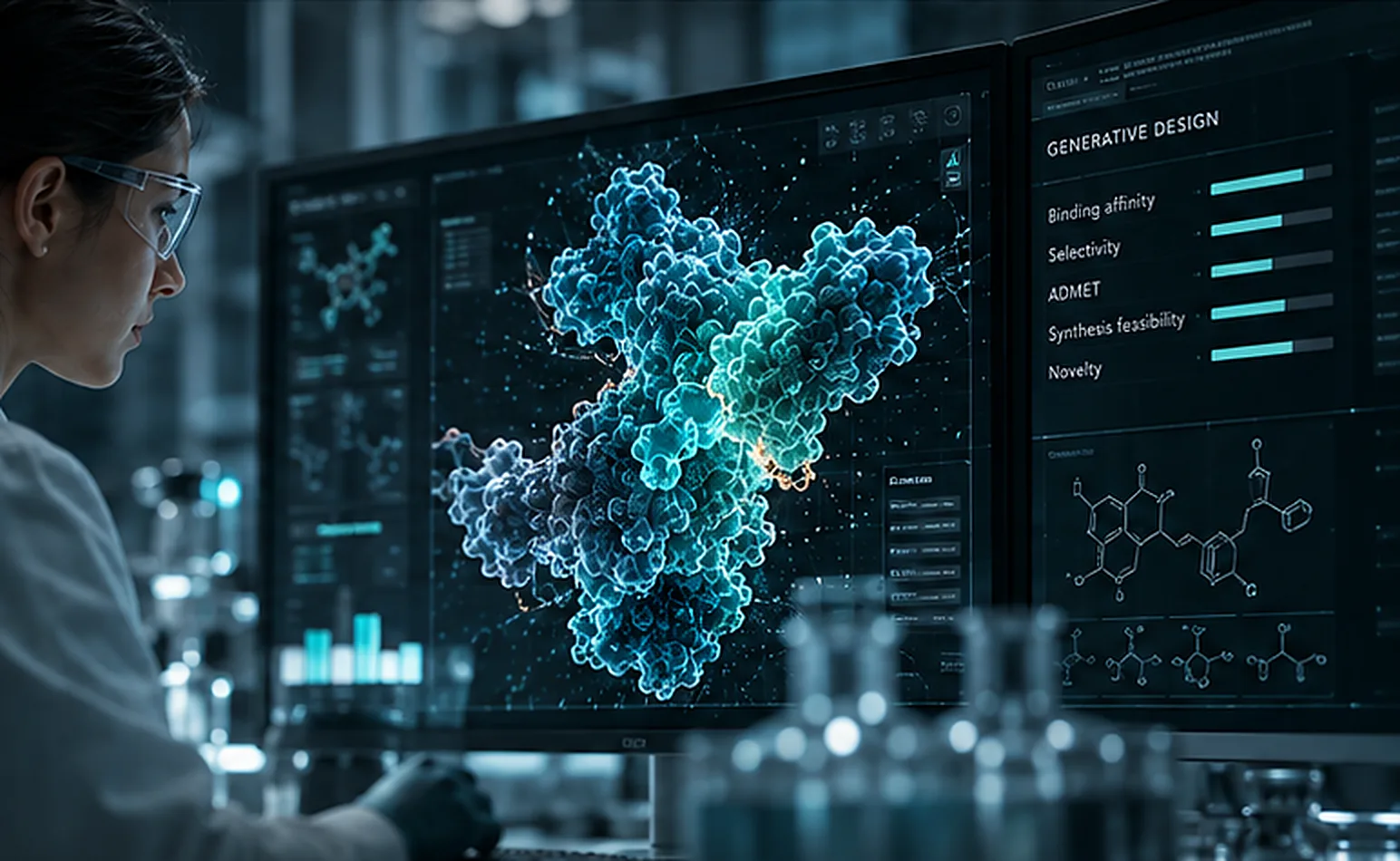
We fuse machine learning with physics-based simulation and real experimental data to identify and optimise therapeutics faster — and with a clearer view of the risks.
- Learned modelsGraph, transformer and diffusion models for molecules, proteins and cells.
- Physics-based simulationFree-energy methods and molecular dynamics where accuracy matters most.
- Calibrated uncertaintyEvery prediction carries a confidence estimate that guides the next experiment.
Methods
The toolbox
Knowledge graphs
Relationships between genes, pathways, diseases, compounds and trials, queryable and explainable.
Omics models
Representation learning on bulk and single-cell data to detect disease states and drivers.
Generative chemistry
Pocket-conditioned diffusion and graph generation with multi-objective optimisation.
Protein and antibody models
Structure prediction and sequence models for binding and developability.
Molecular simulation
Docking, free-energy perturbation and long-timescale molecular dynamics.
Active learning
Choosing the experiments that reduce model uncertainty most per assay.
Principle
Models earn trust at the bench
We benchmark models prospectively — on experiments run after the prediction was made — rather than only on retrospective test sets, which tend to flatter performance.
Negative results are kept, labelled and used. They are often the most informative data a model sees.
- Prospective validation
- Calibrated confidence
- Full experiment lineage
Computational scientist? Come build with us.
We hire across machine learning, cheminformatics, structural biology and data engineering.